
Montenegro's Hidden Gem Wineries: Why Small Estates Offer Better Experiences
Most visitors planning a Montenegro wine trip default to the largest name they can find. That instinct makes sense on paper: bigger usually means more established, more polished, easier to book. It's also, for a certain kind of traveler, exactly backward. The most memorable wine experiences in Montenegro tend to come from its smallest producers, family-run estates where the person pouring your glass is also the person who grew the grapes in it.
What Montenegro's Largest Wineries Offer
It's worth being clear-eyed about what the country's biggest producer actually is. Plantaže, based just outside Podgorica, farms the largest single-plot vineyard in Europe, roughly 2,310 hectares planted with over 11 million vines, and bottles somewhere in the range of 15 to 17 million liters of wine a year for export to more than 35 countries. Its guided tours run through an underground cellar built inside a former military aircraft hangar, led by trained staff on a fixed itinerary. It's an impressive operation, and for visitors who want a polished, large-scale introduction to Montenegrin wine, it's a legitimate first stop.
What that scale doesn't offer is intimacy. A production run in the millions of liters means tastings built for volume and consistency, guided by rotating staff working from a script, in groups that can run into the dozens. That's simply the tradeoff of scale, not a criticism of it. It just isn't the same experience as sitting across from the person whose family has worked the land for generations.
A 28th-Generation Winemaker as Your Host
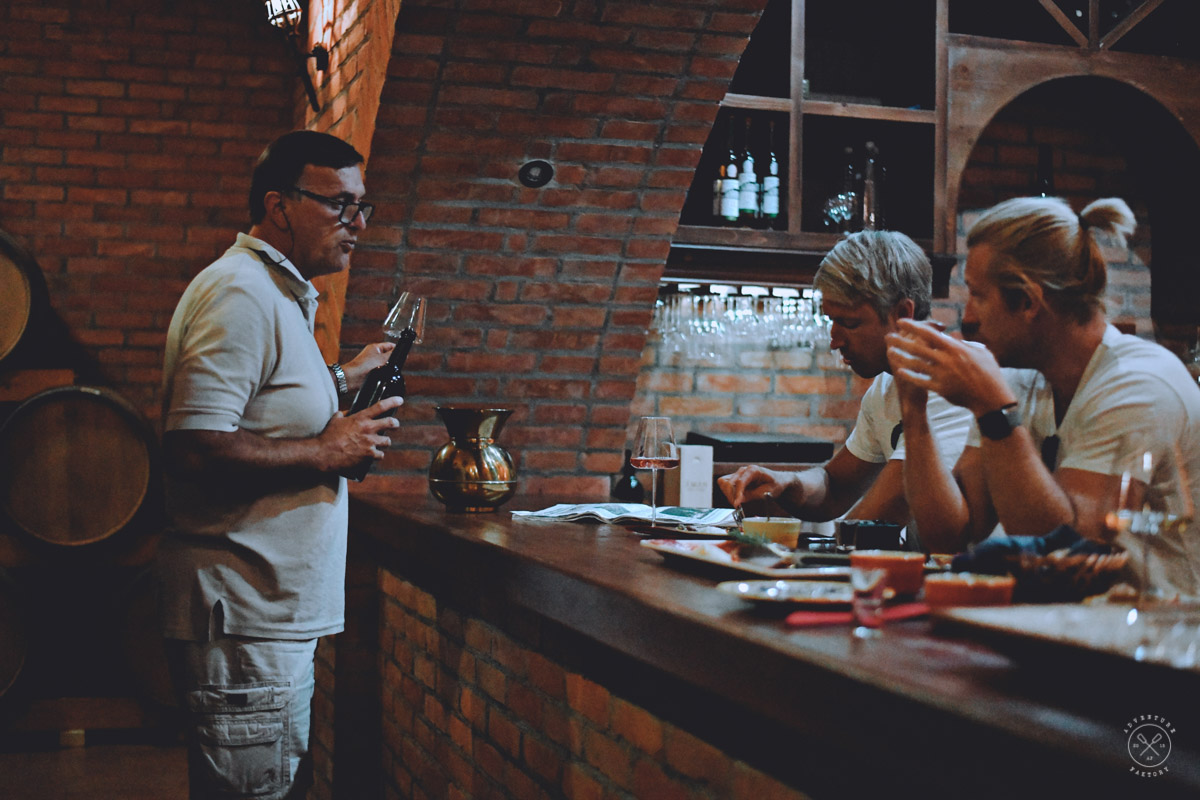
At Radevic Estate, tastings are hosted directly by the family that owns and works the vineyard, continuing a winemaking tradition on this land that stretches back twenty-eight generations. That isn't a marketing figure. It means the person pouring your wine can tell you, firsthand, why a particular vintage turned out the way it did, what changed in the vineyard that year, or the story behind a wine like the estate's own Renée White Fortified Dessert Wine, in a way no rotating tour guide working from a script ever could. At a large commercial winery, you're a group moving through a facility. At a small estate, you're a guest at someone's table.
Food Pairings You Won't Find on a Restaurant Menu
The food served alongside a Radevic Estate tasting isn't catered or restaurant-prepared. It's sourced from village neighbors in Rogami, the same small community the estate has been part of for generations: cured meats, cheese, and small bites made by people the Radević family actually knows. That's a meaningfully different experience from a winery restaurant serving a standardized menu to hundreds of guests a day. It also means the pairing itself has a story behind it, not just a description on a card.
Wines You Can Only Get Here
Radevic Estate produces a small enough volume that several of its wines, including the award-winning Renée White Fortified Dessert Wine, are difficult to find through retail channels outside Montenegro, and command a meaningful premium on the rare occasion they do turn up through international wine merchants. Tasting them at the source isn't just more atmospheric, it's often the most practical way to actually try them. Large commercial producers, by contrast, exist specifically to be found on store shelves and restaurant lists around the world. That's their strength. It's also exactly what a boutique estate can't and doesn't try to compete on.
A Personal Connection to the Land
Radevic Estate's vineyard sits five minutes from Duklija, the ruins of a Roman provincial city, on the same stretch of the Zeta River plain that has been under cultivation for two millennia. The estate's own history traces its family's winemaking roots on this specific plot back twenty-eight generations, through empires, occupations, and the Communist era, to the present. A large commercial winery can tell you about Montenegro's wine history in general terms. A family estate that has lived through twenty-eight generations of it on the same hillside can tell you what that history actually felt like, because it's their own family's story.
Small vs. Large: What Actually Changes
The differences between a boutique estate visit and a large commercial winery tour come down to a handful of concrete things:
Group size: small estates typically host two to ten guests at a time; large producers can run tours for dozens of visitors simultaneously
Who's pouring: at a family estate, it's often the owner or winemaker directly; at a large winery, it's typically rotating trained staff
The food: locally sourced from neighbors at a small estate, versus a standardized restaurant menu at a large producer
Wine access: small estates often pour wines that are hard or impossible to find in retail; large producers are built for wide distribution
The story you leave with: a personal, specific family history at a small estate, versus a general regional overview at a large one
Neither model is wrong. They're built for different kinds of visitors. But if what you're looking for from a Montenegro wine trip is a genuine, personal connection to the place and the people who make the wine, the small estates are where that actually happens.
Frequently Asked Questions
Are small wineries in Montenegro open to visitors, or do they mostly sell to restaurants and shops?
Most, including Radevic Estate, are open for tastings, but almost always by appointment only rather than walk-in visits. Booking ahead is essential, since small estates run tours in small groups rather than on a continuous drop-in schedule.
Is a small winery visit more expensive than a large commercial winery tour?
Not necessarily. Radevic Estate's tastings are priced comparably to, or below, tours at Montenegro's largest producers, despite offering a smaller group size and direct access to the winemaking family.
Do small Montenegrin estates sell wine that isn't available anywhere else?
Often, yes. Limited production volumes mean some wines, including several of Radevic Estate's award-winning bottlings, are difficult to find through retail channels outside Montenegro, which makes tasting them at the source one of the only practical ways to try them.
How far in advance should I book a small-estate tasting?
At Radevic Estate, at least 24 hours' notice is required, though booking further ahead is recommended during peak travel season, since group sizes are intentionally kept small.
Can I combine a small winery visit with other sightseeing nearby?
Yes. Radevic Estate sits five minutes from the Roman ruins of Duklija, making it easy to pair a tasting with a half-day of history and wine in the same trip.
Experience the Small-Estate Difference
The best way to understand what sets a boutique Montenegrin estate apart is to sit at the table yourself. Book a tasting at Radevic Estate and spend an afternoon with the family that has worked this land for twenty-eight generations, tasting wines you won't find anywhere else. For more on how Radevic Estate fits into the wider Montenegrin wine scene, see our complete Montenegro wine tourism guide.


