
NeDuklija: Montenegro's Most Significant Roman Ruin and How to Visit It
Three kilometers north of Podgorica, at the confluence of the Moraca and Zeta rivers, lie the ruins of Doclea. Known in Montenegrin as Duklija, this is the most thoroughly explored Roman town in the southeastern part of the former province of Dalmatia, and according to the UNESCO World Heritage tentative listing, the most significant archaeological site in Montenegro. It is almost entirely absent from mainstream English-language travel coverage. Most visitors to Podgorica do not know it exists. Those who do find it are rewarded with free entry, genuine Roman ruins spanning over 30 hectares, and a setting bounded by river canyons and mountain ridges that has not fundamentally changed in two thousand years.
What Was Doclea?
Doclea was a fully functioning Roman provincial city of 8,000 to 10,000 inhabitants, established as a municipium during the reign of Emperor Vespasian in the 1st century AD and elevated to capital of the Roman province of Prevalis during Diocletian's administrative reforms at the end of the 3rd century.
The settlement predates Roman administration. Duklja is first mentioned by Ptolemy in the 2nd century BC as the principal town of the Illyrian Docleatae tribe. Under Roman rule it became the most advanced urban center in the territory that is now Montenegro, with the full infrastructure of a provincial city: a Forum, Basilica, temples, thermal baths, an aqueduct, paved streets on the Roman cardo and decumanus grid, and residential villas surrounded by productive agricultural land.
The city's name gave its name to the entire region. The territory around it was called Dioklitija, and that name persisted in various forms until the 11th century, when it was gradually replaced by Zeta. The modern name Montenegro, meaning Black Mountain, came later still. In historical terms, Doclea is the oldest layer of the country's identity as a defined place.
Doclea's fall was rapid. The city was sacked by the Ostrogoths in the late 5th century and struck by a severe earthquake around 518 AD. Unlike many Roman towns that transformed into medieval settlements, Doclea was never rebuilt. Its stones were quarried for construction elsewhere and its site slowly returned to farmland and meadow, which is partly why the ruins are accessible across an open landscape today rather than buried under centuries of subsequent building.
One persistent legend connects Doclea to the Roman Emperor Diocletian, who some sources claim was born in the city or its vicinity. While this claim is debated by historians, the official Montenegro tourism authority references it, and the naming resonance between Diocletian and Dioclea is striking enough to have sustained the tradition across two millennia.
What Can You See at the Site Today?
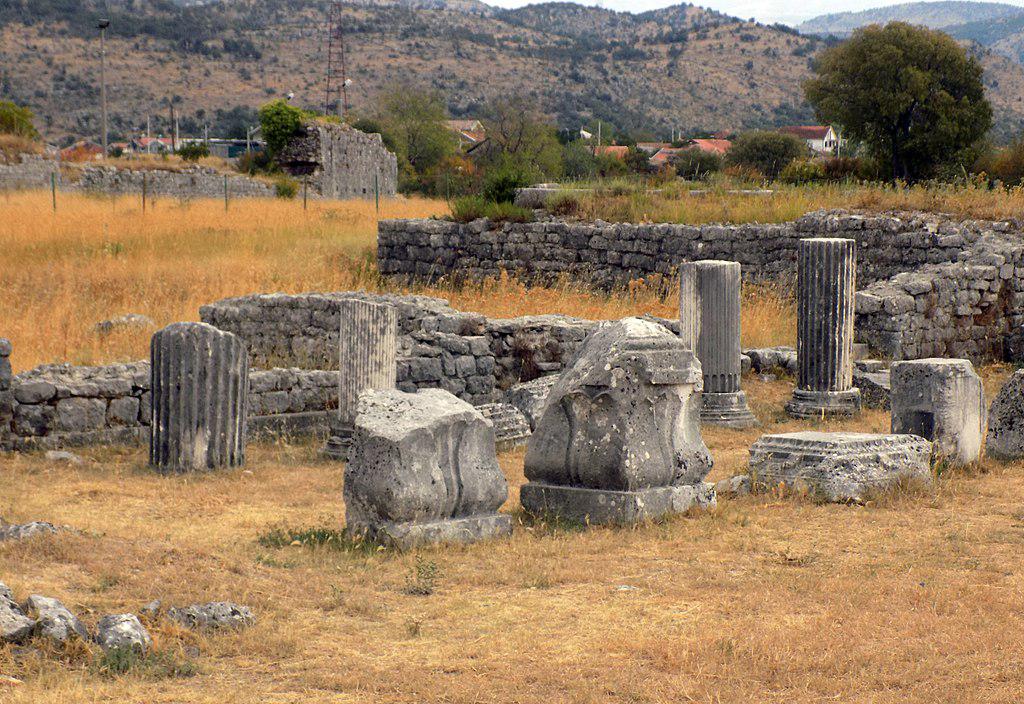
The site covers over 30 hectares and includes the remains of the Forum, Basilica, temples of Diana and Roma, thermal baths, city walls, a southeast necropolis, and an Early Christian basilica. Entry is free. Sturdy footwear is essential.
The list below outlines the main surviving structures and what each tells visitors about life in this Roman provincial capital:
Forum and Basilica
What remains: the central axis, column bases, and stone floor sections. This was the administrative and civic heart of Doclea, forming the axis of the cardo and decumanus road grid that organized the entire city.
Temples of Diana and Roma
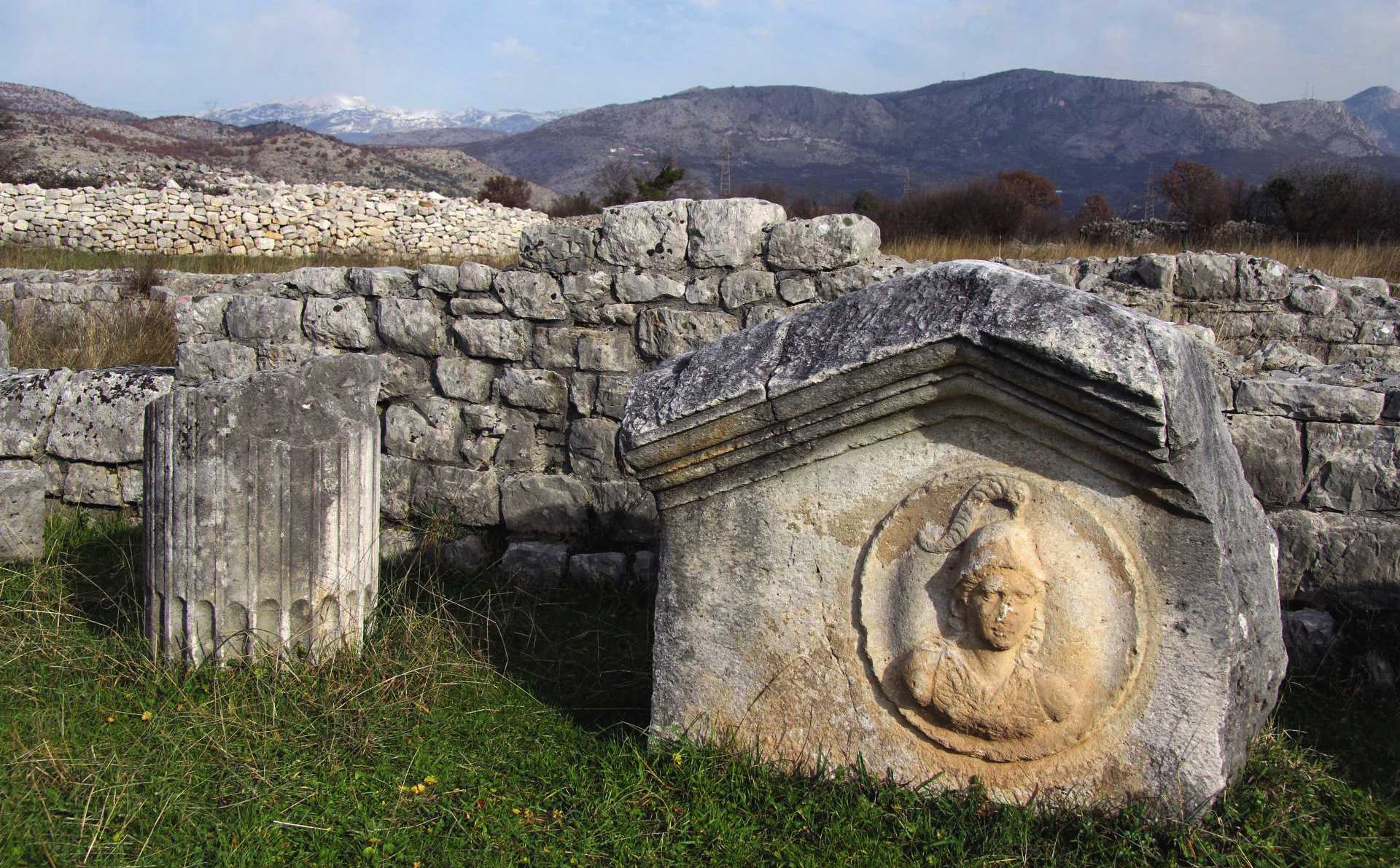
What remains: column remnants, foundations, and a sculpted figure of the goddess Diana. These were the principal religious structures of the city, and the Diana statue is among the most photographed elements on the site today.
Town Thermal Baths
What remains: foundation walls, drainage channels, and partial floor sections. These are evidence of developed Roman infrastructure and urban comfort in a first century AD provincial city.
City Walls and Ramparts
What remains: sections of perimeter wall in varying states of preservation. These defined the boundary of a city that held between 8,000 and 10,000 inhabitants at its peak.
Southeast Necropolis
What remains: over 300 excavated tombs, sarcophagi, and inscriptions dating from the first to the fourth century. Excavations here yielded jewelry, glassware, and the famous Glass of Podgorica.
Early Christian Basilica
What remains: church foundations with a visible nave and altar orientation. This represents the post-Roman layer of the site, showing Doclea's continued religious significance into the Byzantine period.
The site has two distinct areas. The main fenced section to the north contains the Forum, temples, and principal civic structures, with information boards in Serbian and English. Across the road to the south, a less formalized area contains the Early Christian basilica ruins and paths that lead down to the riverbank of the Moraca, where the setting is particularly beautiful in good weather.
The most famous object ever recovered from Doclea is not at the site itself. The Glass of Podgorica, a 4th century early Christian artifact decorated with Old and New Testament scenes, was excavated here in the mid-19th century and is now held in the collection of the Hermitage Museum in St. Petersburg, Russia. It is the exhibit that put Montenegrin archaeology on the international map. Smaller artifacts from the site, including jewelry, coins, ceramic dishes, and sarcophagi, are held at the Podgorica City Museum, which is worth visiting before or after the ruins for the additional context it provides.
Practical Visitor Information
Doclea is free to enter, open year-round, and located approximately 3 kilometers north of central Podgorica. The site is best approached by car, which takes 10 minutes from the city center, or by local bus L20, which takes 30 to 45 minutes.
Location: Confluence of the Moraca and Zeta rivers, north of Podgorica. Get directions via Google Maps.
Entry: Free of charge. The gated main section is usually open; if the gate appears locked, check before assuming it is closed, as visitors report it is frequently unlocked even when it looks otherwise.
By car: 10 minutes from central Podgorica via the old road toward Danilovgrad along the left bank of the Moraca river. Parking is available at the site.
By bus: Local bus L20 from Podgorica city center takes 30 to 45 minutes and costs approximately 0.90 EUR each way. The same ticket can be used for the return journey.
What to wear: Sturdy flat shoes are essential. The terrain is uneven grass and stone. Parts of the site flood seasonally. High heels are not appropriate.
Time required: Allow 45 to 90 minutes for a thorough visit of both the main fenced section and the south side near the river. Budget additional time if you plan to walk to the riverbank.
Signage: Information boards in Serbian and English are present on the north side. The south side has no signage. Having a brief background before you arrive significantly improves the experience.
Set expectations appropriately. Doclea is a genuine unrestored Roman ruin, not a polished heritage attraction. The grass is high in summer, some structures require imagination to read, and the site has been inconsistently maintained over the years. Visitors who approach it with curiosity and historical context consistently describe it as one of the most rewarding experiences near Podgorica. Visitors expecting the Colosseum will be disappointed.
Combining Doclea with a Visit to Radevic Estate
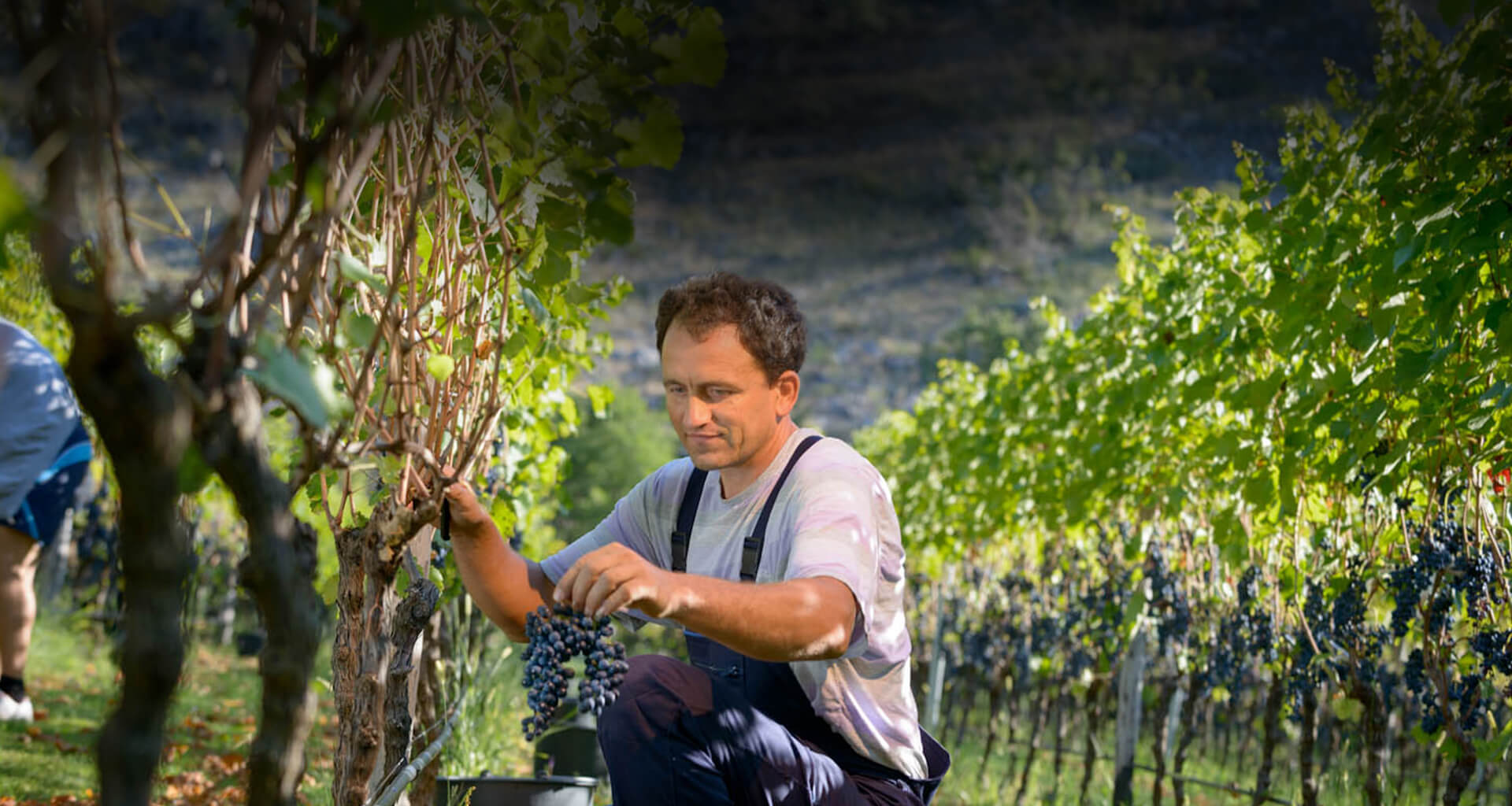
Doclea and Radevic Estate are 5 minutes apart by car and together make a natural half-day excursion from Podgorica that covers two thousand years of the same landscape's history, from Roman provincial capital to a winery that has cultivated these same vineyards for twenty-eight generations.
The Radevic Estate vineyard sits directly adjacent to the ruins of Duklija, near the ancient Roman city of Dolcea, on the same Zeta River plain where Roman governors once administered one of Dalmatia's most significant provincial towns. The estate history page describes this connection explicitly: the Radevic family traces its winemaking roots back through twenty-eight generations in this specific landscape, a lineage that reaches back toward the same period that Doclea was functioning as a going concern.
The Third Crusade connection reinforces this. When Frederick Barbarossa's forces passed through this area in the late 12th century, centuries after Doclea's fall but on the same road through the Zeta valley, they noted the quality of the local wine. The vineyards Radevic Estate tends today grow in the same soil, in the same microclimate, fed by the same rivers that supplied Doclea's aqueduct and separated its necropolis from its forum.
For a visitor arriving from Podgorica with a morning or afternoon free, the combination is straightforward. Visit the ruins first, while the history is fresh context, then drive five minutes to the estate for a two-hour tasting that puts a glass of wine grown in that exact landscape into your hand. The effect of drinking estate-grown Vranac five minutes from a Roman Forum where wine was traded two thousand years ago is not something most itineraries in Europe can offer.
Suggested Half-Day Sequence
Morning (or early afternoon): Drive from Podgorica to Doclea ruins (10 minutes). Spend 60 to 90 minutes at the site. Visit both the main fenced section and the south side near the Moraca riverbank.
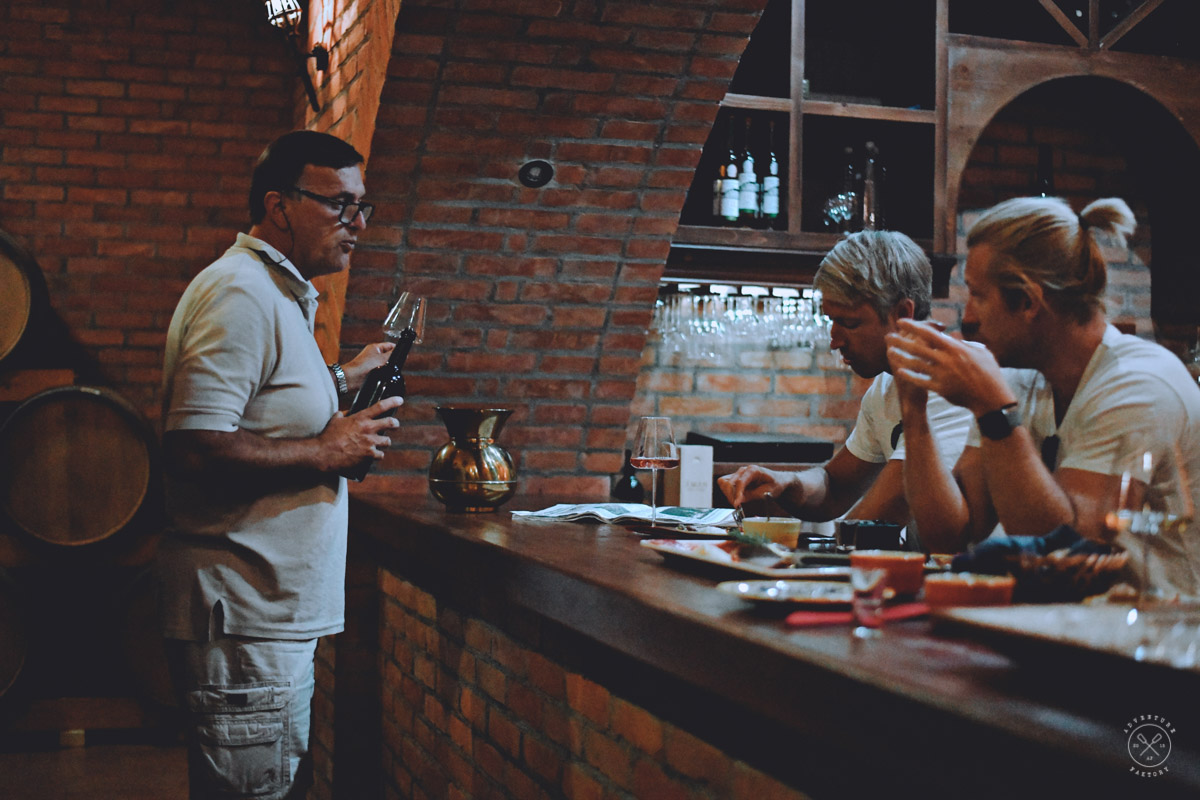
Mid-morning (or mid-afternoon): Drive 5 minutes to Radevic Estate in Rogami. Book in advance (minimum 24 hours notice required). The full estate experience lasts approximately two hours and includes a vineyard and winery tour, six wines, the signature cognac, and small-bite food pairings.
Total time from Podgorica: Approximately half a day, including travel, ruins, and tasting. The combination fits comfortably into a morning or afternoon without rushing either experience.
Why Doclea Matters Beyond Montenegro
The UNESCO tentative listing for Doclea describes it as not only the most significant archaeological site in Montenegro but also the most thoroughly explored town in the southeastern part of the Roman province of Dalmatia. Its urban plan, the relationship between its Forum, temples, thermal baths, and necropoli, offers one of the clearest surviving examples of Roman provincial urban design in the western Balkans. The city's role as capital of the province of Prevalis under Diocletian's administrative reforms gives it a specific historical function that most Roman provincial towns did not hold.
What makes it particularly valuable for visitors interested in Roman history is precisely its underdeveloped state. In Dubrovnik or Split, Roman structures are surrounded by medieval and modern layers that require effort to isolate. At Doclea, the Roman plan is legible across an open landscape without subsequent building obscuring the relationship between structures. The Forum axis, the temple positions, the necropolis locations relative to the city walls: all of these are visible in their original spatial relationship because nothing was built on top of them.
For visitors building a broader Montenegro itinerary, Doclea connects to the wider historical narrative covered in the complete Montenegro wine tourism guide, which traces the country's wine history from Greek colonization through the Roman period and into the present. The ruins and the vineyard next door are two chapters of the same story.
Plan Your Visit: Duklija and Radevic Estate
Doclea ruins are free to enter and open year-round, approximately 10 minutes by car from central Podgorica. No booking is required. Bring sturdy shoes and allow 60 to 90 minutes.
Radevic Estate is 5 minutes from the ruins by car, open by appointment only, Monday through Sunday 10am to 8pm, February through December. Groups of 2 to 10. Book through the Visit Us page at radevicestate.com, by calling +382-69-276-055, or by emailing [email protected]. Advance booking of at least 24 hours is required.
For full practical details on visiting the estate including tasting tiers, what to bring, and seasonal advice, see the complete visitor guide.


